|
Edward
J. Huxtable
He was born in 1913 in Douglas, Ariz. His father owned one of the town’s first drug stores and was active in civic affairs, including aviation promotion. Douglas had the first international airport in the Americas. In 1933, it ranked as one of the 10 best airports in the U.S. When Huxtable Sr. became the town’s postmaster, he helped place Douglas on the first, regularly scheduled, federal airmail route. While still attending Douglas High School, Huxtable Jr. became a member of Arizona’s civilian, high-power rifle team that competed at national matches. After gaining admission to the U.S. Naval Academy, Huxtable was on its outdoor rifle team, and football team, until his 1936 graduation. Huxtable served on the cruiser USS Quincy and the
destroyer USS Truxton before beginning flight training. By 1940,
he was part of the scouting squadron aboard the carrier USS Ranger.
He also served with the USS Yorktown’s anti-submarine squadron
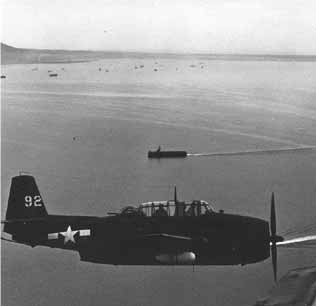
as that carrier escorted troop ship convoys across the Atlantic. In the subsequent six-week campaign in the Mariana Islands, Huxtable showed a torpedo bomber could perform a fighter plane’s work and earned a Distinguished Flying Cross. The citation accompanying the medal cited Huxtable’s intelligent leadership and his squadron’s ability to successfully complete exacting and dangerous work. This included notably accurate bombing near the Tinian landing beach, attacking enemy artillery and low-level flying in a gully to strafe enemy troops. On Oct. 24, 1944, the Gambier Bay as part of Taffy 3, a 12-ship task force, provided air cover for troops invading Leyte Island in the Philippines. Early the next morning, an 18-ship Japanese fleet surprised Taffy 3. Mishaps the night before in the hangar and on the flight deck meant Gambier Bay’s planes weren’t ready for quick launch Oct. 25. Huxtable took off with only 100 rounds in his guns and no torpedoes. For the next two hours, he tried to distract the Japanese ships by making dummy runs. The first time he dived toward the enemy, the antiaircraft fire was so intense he pulled out. He then paralleled the Japanese ships on a reverse course, 3,000-4,000 yards out. Even this maneuver drew fire and Huxtable flew through the smoke of some bursts. He’d just survived the antiaircraft fire of eight heavy cruisers, despite flying straight down their line. Huxtable then flew past four Japanese battleships while trying to give the impression he’d drop a bomb or torpedo although he had none. It was a feat for which Huxtable would later receive a Silver Star. Huxtable next radioed a course proposal to Taffy 3’s commander and then called the Gambier Bay. The assistant air officer suggested Huxtable arm on Leyte’s Tacloban Airfield. Huxtable disregarded the suggestion, thinking that since troops had gone ashore only two days before there’d be no bombs at Tacloban. He continued feigning torpedo drops as the Japanese fleet concentrated its fire on the Gambier Bay. Slightly more than three hours after spotting the Japanese, the Gambier Bay became the only U.S. aircraft carrier sunk by naval gunfire during World War II. Huxtable and his squadron had no place to land. Gambier Bay’s sister ship, the St. Lo, was blown up by a kamikaze, and the other CVE carriers were heavily damaged. But Taffy 3’s planes and destroyers damaged five Japanese cruisers and the fleet flagship. That plus knowledge of another American flotilla in the area made the Japanese commander order retirement. Huxtable finally landed at Dulag airstrip. Eventually, he and his men got back to California, where Huxtable reformed VC-10. Assigned to the USS Fanshaw Bay, VC-10 did another duty tour in the Pacific. On Aug. 31, 1945, Fanshaw Bay became the first aircraft carrier to drop anchor in Japanese homeland waters. On Sept. 10, Huxtable flew to Tokyo to deliver surrender papers to the Japanese Northern Army. On Sept. 30, VC-10 was decommissioned. Huxtable’s tenure as its commander was the longest of any CVE unit in U.S. Naval history. Promoted to captain before retiring from active service in 1949, Huxtable returned to Douglas. He held several jobs, including flight instructor at Douglas Municipal Airport, which his father helped found two decades before. He died in 1985. The next year, VC-10 members decided to honor their leader by placing a plaque on board the Yorktown. Several of Huxtable’s men contributed memories of him. Here are two. Jesse Holleman said: "As you all know, I was severely burned when my plane was shot down in Saipan and burst into flames as it hit the water. I was sent back to the naval hospital in San Diego. … " "I was in pretty bad shape and was sitting on the edge of my hospital bed with the nurse massaging my legs trying to get the blood to circulate, when the door opened and there was Hux smiling at me. I hadn’t walked a step up to this time, but I got up and walked halfway across that room to him." "After he and the squadron had gone through the Battle of Leyte, the first thing he did upon reaching the U.S. was to come to the hospital to see me. I never forgot that. I know a part of Hux will always be with each of us." John G. Holland said: "I was Hux’s personnel officer. There were just two of us non-flying officers in the squadron – myself and Vereen Bell, the air combat intelligence officer… . " "Ours was a unique friendship for we were older than those pilots who were 19, 20, 21 years of age. We were almost the same age and in our early 30s. … " "There was an amazing quality in Hux that was not to be found in other officers, particularly among Annapolis grads. … He was unique in his relationship with his men. They came to respect, admire and love him then and they continue to do so now." Holland remembered clinging to a floating plank with Bell after the Gambier Bay sank. "I had sighted some of our men and swam over to where they were to see how they were," said Holland. "When I returned, Bell had let go and was gone. He had been close to Hux and Hux never got over losing Bell or others of his men. He truly loved those men like sons." Holland quoted Huxtable at the dedication ceremony. He shared the last pages of Huxtable’s autobiography. Huxtable wrote: "It was an honor and a privilege to have command of such a wonderful group of men as these, both officers and enlisted men. The proudest satisfaction of both cruises I could feel was that in the second squadron we did not lose a man." "To those that we did lose in the first squadron, I would like to quote from James Whitcomb Riley – ‘I cannot say, and I will not say, that he is dead. ‘He is just away, with a cheery smile and a wave of his hand. ‘He wandered into an unknown land.’ "I feel very deeply," Huxtable wrote, "the loss of all my men and I feel sometime, somewhere, we will meet again. My feeling is that God will let us be together again." © 2001 Cindy Hayostek |
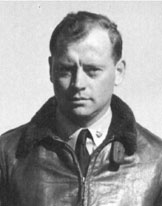 Commander
of VC-10, the Gambier Bay’s composite squadron (fighter and dive
bomber planes), was Edward J. Huxtable Jr.
Commander
of VC-10, the Gambier Bay’s composite squadron (fighter and dive
bomber planes), was Edward J. Huxtable Jr.